Understanding Green Pool Water: Common Causes in Phoenix
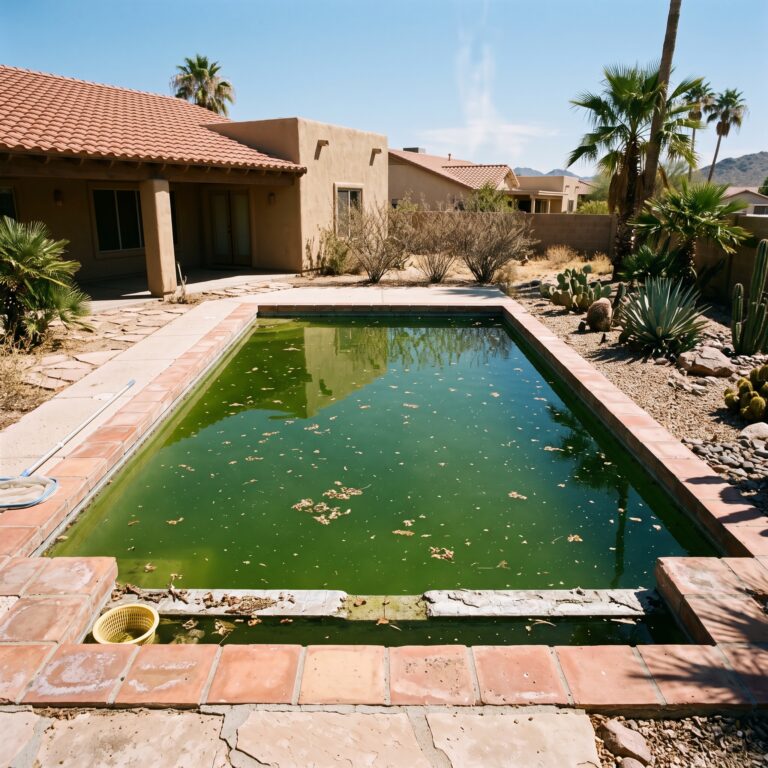
If you’ve walked outside to find your swimming pool has turned an alarming shade of green, you’re facing one of the most common pool problems in Phoenix. That crystal-clear water you enjoyed yesterday can transform into a murky green overnight, especially during our brutal summer months.
The culprit behind your green pool is almost always algae. These microscopic organisms thrive in Phoenix’s unique conditions, reproducing at astonishing rates when they find the perfect environment. In fact, pools in the Phoenix metropolitan area experience algae blooms approximately 70% more frequently than the national average due to our extreme climate.
When algae spores land in your pool water, they can multiply rapidly—doubling their population every 3-4 hours in ideal conditions. This exponential growth explains why your pool can look fine in the morning and resemble a swamp by evening, particularly after a monsoon or dust storm passes through.
Understanding why Phoenix pools are so susceptible to turning green requires recognizing the perfect storm of factors our desert environment creates This is where professional pool maintenance becomes essential.:
- Extreme heat – Water temperatures above 85°F accelerate algae reproduction
- Intense UV exposure – Rapidly degrades chlorine, leaving your pool vulnerable
- Dust storms – Deposit phosphates and other nutrients that feed algae
- Hard water – High mineral content interferes with chemical effectiveness
- Monsoon humidity – Creates ideal growth conditions when combined with heat
The Phoenix Factor: How Desert Climate Affects Pool Chemistry
The Phoenix climate creates pool maintenance challenges unlike anywhere else in the country. When summer temperatures routinely hit 110-115°F, your pool chemistry changes rapidly, often within hours rather than days.
Ultraviolet radiation is particularly intense in our desert environment. Phoenix averages over 300 sunny days annually with UV index readings frequently exceeding 10 (extreme) during summer months. This intense sunlight accelerates chlorine degradation through a process called photolysis, where UV rays break down hypochlorous acid—the active sanitizing component in chlorine. In practical terms, your pool can lose 30-50% of its free chlorine within just 2-3 hours during peak afternoon sun.
Evaporation compounds these challenges. A typical Phoenix pool loses approximately 1-2 inches of water weekly during summer—significantly higher than the national average of 0.25-0.5 inches. This rapid evaporation concentrates minerals and impurities in the remaining water, destabilizing your carefully balanced chemistry.
Dust storms, particularly during monsoon season, introduce massive amounts of debris and nutrients into your pool. A single haboob can deposit several pounds of dust into an average-sized pool, introducing phosphates (algae’s primary food source), nitrates, and organic matter. These dust particles also harbor dormant algae spores just waiting for favorable conditions to bloom.
The cycle typically works like this: A dust storm deposits phosphates and algae spores, the intense heat warms the water to ideal growth temperature, UV radiation degrades your chlorine levels, and within 24-48 hours, you’re looking at a green pool situation.
Arizona’s Hard Water and Mineral Content
Water hardness is another significant factor that makes Phoenix pools particularly susceptible to turning green. Arizona’s water supply, primarily from the Central Arizona Project (CAP) and Salt River Project (SRP), contains high levels of calcium, magnesium, and other minerals that create water hardness ranging from 200-400 ppm—nearly twice the recommended maximum for pools.
These minerals directly interfere with your pool chemicals’ effectiveness. Hard water reduces chlorine efficiency, making it less able to kill algae and bacteria. The high mineral content also tends to push pH and alkalinity levels upward, often beyond the ideal range of 7.4-7.6 pH.
When total dissolved solids (TDS) accumulate beyond 1,500 ppm, which happens quickly in Phoenix pools due to evaporation, chemical effectiveness decreases dramatically. Even properly dosed chemicals may appear to “do nothing” in these conditions.
| Mineral/Parameter | Phoenix Average | National Average | Impact on Pool |
|---|---|---|---|
| Calcium Hardness | 250-400 ppm | 150-250 ppm | Scale formation, reduced chlorine efficiency |
| Total Dissolved Solids | 800-2000 ppm | 200-800 ppm | Reduced chemical effectiveness |
| pH (untreated) | 7.8-8.2 | 7.2-7.8 | Decreased sanitizer effectiveness |
Diagnosing Your Green Pool: Types of Algae Common in Arizona
Not all green pools are created equal. Identifying exactly what type of algae you’re dealing with is crucial for effective treatment, as different varieties require different approaches—especially in Phoenix’s challenging conditions.
Green algae is by far the most common culprit in Phoenix pools, accounting for about 85% of all algae problems. It appears as a free-floating organism that turns water from hazy teal to pea soup green depending on concentration. This type typically responds well to proper chlorine levels and filtration, though Phoenix’s heat and UV exposure make it more persistent than in other regions.
Black algae, while less common (about 10% of cases), is much more difficult to eliminate. Despite its name, it actually appears as blue-green or black spots, typically in shaded areas or on rough surfaces like plaster or grout lines. What makes black algae especially problematic is its protective outer layer—a biofilm that shields it from chemicals. It also sends roots deep into porous surfaces, making it extremely resistant to standard treatments.
Yellow or mustard algae appears as a yellowish powder or slime, typically in shaded areas of the pool. It’s relatively rare in Phoenix (about 5% of cases) but becomes more common during the mild winter months when pool usage decreases. Yellow algae is often mistaken for pollen or sand but is actually chlorine-resistant and returns quickly if not properly treated.
Pink “algae” isn’t actually algae at all, but a bacteria called Serratia marcescens. It appears as a pinkish slime, usually along the waterline or in plumbing. It’s relatively uncommon in properly maintained Phoenix pools but can appear in systems with inadequate circulation.
Each algae type spreads through spores that can remain dormant until conditions are favorable. In Phoenix’s climate, these spores can activate and multiply within hours when chlorine levels drop or after weather events like dust storms or monsoon rains.
| Algae Type | Appearance | Causes in Phoenix | Difficulty to Remove | Treatment Approach |
|---|---|---|---|---|
| Green Algae | Free-floating, green cloudy water | Low chlorine, high heat, dust storms | Moderate | Shock treatment, filtration, algaecide |
| Black Algae | Dark spots with strong roots | Porous surfaces, shaded areas | Very difficult | Heavy brushing, high shock, specialty algaecide |
| Yellow/Mustard Algae | Yellowish powder in shaded areas | Low circulation, winter conditions | Difficult | Specialty algaecide, shock, thorough brushing |
| Pink Slime | Pinkish film at waterline | Poor circulation, biofilm formation | Moderate | Enzyme treatments, chlorine, circulation |
Test and Balance: The Critical First Step for Phoenix Pools
Before tackling your green pool problem, proper water testing is absolutely essential. In Phoenix’s unique environment, standard pool advice often falls short because our water chemistry behaves differently under extreme conditions.
Start with a reliable testing method—either test strips, liquid test kits, or ideally, a digital tester for accuracy. Your first priority is identifying where your water chemistry currently stands. At minimum, you need to test for:
- Free chlorine (FC)
- pH
- Total alkalinity (TA)
- Cyanuric acid (CYA)
- Calcium hardness
In Phoenix pools, pH tends to run high (above 7.8) due to our hard water and dust. The problem? When pH exceeds 7.6, chlorine’s effectiveness drops dramatically—by over 50% at pH 8.0. This means even with seemingly adequate chlorine readings, your sanitizer isn’t working efficiently, leaving your pool vulnerable to algae.
Alkalinity acts as a buffer for pH, preventing rapid changes. In Phoenix, target 80-120 ppm—slightly higher than some standard recommendations to account for our rapid evaporation rates.
Cyanuric acid stabilizer is particularly critical in our intense sunlight. It protects chlorine from UV degradation, extending its effectiveness from minutes to hours. However, Phoenix pool owners face a delicate balance. Too little CYA (below 30 ppm) and chlorine dissipates quickly; too much (above 80 ppm) and you’ll experience “chlorine lock”—where free chlorine becomes bound and ineffective against algae.
| Parameter | Ideal Range for Phoenix | Standard Range | Adjustment |
|---|---|---|---|
| Free Chlorine | 2-4 ppm | 1-3 ppm | Increase due to rapid UV degradation |
| pH | 7.4-7.6 | 7.2-7.8 | Narrower range for better chlorine efficiency |
| Total Alkalinity | 80-120 ppm | 80-120 ppm | Monitor frequently due to evaporation |
| Cyanuric Acid | 30-50 ppm | 30-80 ppm | Lower maximum to prevent chlorine lock |
| Calcium Hardness | 200-400 ppm | 180-220 ppm | Higher due to hard water source |
Proven Step-by-Step Process to Fix a Green Pool in Phoenix
Restoring your green pool to crystal clear condition requires a systematic approach specifically adapted for Phoenix conditions. Our extreme heat, intense UV exposure, and unique water chemistry demand modifications to standard treatment protocols.
Before beginning treatment, understand that the intensity of green color indicates the severity of your algae problem. Light green water typically means moderate algae growth (10,000-100,000 algae cells per ml), dark green indicates heavy infestation (100,000-1,000,000 cells per ml), and very dark or black-green suggests extreme contamination with possible black algae presence.
Here’s your step-by-step recovery process:
- Balance key chemicals – Adjust pH to 7.2-7.4 (slightly lower than normal maintenance range) to maximize chlorine effectiveness. Verify alkalinity is 80-120 ppm.
- Check cyanuric acid levels – Ensure CYA is 30-50 ppm. If above 80 ppm, chlorine effectiveness will be severely reduced, potentially requiring partial water replacement.
- Remove debris – Skim visible debris and vacuum loose sediment before chemical treatment.
- Shock treatment – Apply calcium hypochlorite shock at dusk (never during daytime in Phoenix) at 2-3 times the normal dose. For a typical 15,000-gallon pool with moderate green algae, this means 2-3 pounds of shock.
- Apply algaecide – After shocking, add a quality algaecide according to the manufacturer’s directions for green pools.
- Brush thoroughly – Brush the entire pool surface to dislodge algae colonies from walls and floor, paying special attention to steps, corners, and shaded areas.
- Maximize filtration – Run your filter system continuously for 24-72 hours, cleaning or backwashing as needed when pressure rises.
Emergency Green Pool Recovery: When Results Are Needed Fast
When you need your green pool cleared quickly—perhaps for an upcoming event or weekend gathering—you can accelerate the process with a more aggressive approach. Be aware that these emergency measures work best for light to moderate algae problems and may not be sufficient for severe infestations.
For the fastest results, implement this emergency protocol:
- Lower pH to 7.0-7.2 (temporarily) to maximize chlorine effectiveness
- Apply a triple-dose shock treatment at dusk (approximately 3 pounds per 10,000 gallons)
- Add a copper-based algaecide immediately after shocking
- Run your pump continuously at maximum flow rate
- Add a water clarifier 8-12 hours after shocking to help coagulate dead algae
- Brush the entire pool surface vigorously every 6-8 hours
- Clean or backwash your filter whenever pressure increases by 8-10 PSI
With this aggressive approach, a light green pool can show significant improvement within 24 hours and may achieve swim-ready clarity within 36-48 hours. Dark green pools typically require at least 72 hours even with emergency treatment.
Keep these emergency green pool recovery supplies on hand during summer months:
- Calcium hypochlorite shock (minimum 10 pounds)
- Liquid chlorine (two 2.5-gallon containers)
- Copper-based algaecide (1-2 quarts)
- Water clarifier (1 quart)
- pH reducer
- Reliable test kit with fresh reagents
- Pool brush with stiff bristles
Deep Cleaning and Brushing Techniques for Arizona Pools
Physical removal of algae through proper brushing is critically important when treating green pools in Phoenix. Chemical treatments alone often fail because algae forms protective biofilms that shield colonies from chlorine and other sanitizers.
The type of brush you use matters significantly. For plaster, concrete, or pebble surfaces, use a stainless steel bristle brush that can effectively remove algae embedded in porous surfaces. For vinyl liners or fiberglass pools, use a nylon bristle brush to avoid surface damage.
Proper brushing technique is crucial for effectiveness:
- Use firm, consistent pressure with overlapping strokes
- Brush walls from the waterline down toward the floor
- Pay extra attention to steps, corners, behind ladders, and shaded areas
- Focus intensively on any visible algae spots or discoloration
- For tile pools, use a grout brush to clean between tiles where algae roots take hold
In Phoenix pools, pay particular attention to the north-facing wall which receives less direct sunlight and frequently harbors persistent algae. Areas around pool features like rock waterfalls or grottos are also common trouble spots that require extra brushing attention.
For black algae spots, which are common in older Phoenix plaster pools, scrub with extreme vigor, even using the edge of a stainless steel brush to break through the protective layer. The goal is to break the outer protective coating of the algae so chemicals can penetrate to the roots.
Shock Treatment Strategies for Phoenix’s Extreme Heat
Shock treatment is the cornerstone of any green pool recovery, but Phoenix’s extreme conditions require significant modifications to standard practices. The intense desert sun can degrade chlorine at astonishing rates, rendering typical shock treatments ineffective within hours instead of days.
The first critical adjustment is timing. Never shock your pool during daylight hours in Phoenix. UV rays will degrade up to 50% of your chlorine within 2-3 hours on a sunny day, wasting both your chemicals and effort. Instead, apply shock after sunset (ideally between 8-10pm) to maximize effectiveness and contact time.
Temperature significantly impacts dosing requirements. As a general rule:
- Standard conditions (below 85°F): 1 lb shock per 10,000 gallons
- Warm conditions (85-95°F): 1.5 lbs shock per 10,000 gallons
- Hot conditions (95-105°F): 2 lbs shock per 10,000 gallons
- Extreme Phoenix heat (105°F+): 2.5-3 lbs shock per 10,000 gallons
For green pool treatment specifically, these dosages should be increased further. A moderate green pool in 105°F+ Phoenix summer conditions may require 3-4 pounds of shock per 10,000 gallons.
The type of shock matters as well. Calcium hypochlorite (cal-hypo) shock is typically more heat-stable than sodium hypochlorite (liquid chlorine), which makes it generally preferred for severe green pool treatments. However, if your pool already has high calcium hardness (above 400 ppm), consider using liquid chlorine instead to avoid further increasing calcium levels.
Cyanuric acid levels critically impact shock effectiveness. If your CYA level exceeds 70 ppm, you’ll need to increase shock dosage by 30-50% to overcome “chlorine lock.” If CYA exceeds 100 ppm, consider partially draining and refilling the pool before treatment, as even massive shock doses may prove ineffective.
Why Conventional Pool Advice Fails in Phoenix
Standard pool maintenance advice found in books or general websites typically addresses pools in moderate climates like California, Florida, or the Midwest. These conventional approaches often fail spectacularly when applied to Phoenix pools for several critical reasons.
Phoenix metropolitan area pools face extreme conditions that pools in other regions simply don’t encounter. While a pool in Chicago might see 80-90°F water temperatures for a few months, Phoenix pools routinely maintain 90-100°F water temperatures for 4-5 months straight. This temperature difference alone accelerates chemical reactions and algae growth rates by 2-3 times compared to moderate climates.
The intensity of Arizona’s ultraviolet radiation cannot be overstated. Phoenix averages a UV index of 10+ (extreme) for nearly half the year, whereas most regions rarely exceed a UV index of 8. This extreme UV exposure degrades chlorine at unprecedented rates, requiring much higher maintenance levels than standard advice suggests.
Hard water in Phoenix contains calcium and magnesium concentrations often 2-3 times higher than national averages, creating unique chemistry challenges. These minerals interact with pool chemicals and create scale deposits that can shield algae from treatment.
The frequency and intensity of dust storms in our region introduce massive phosphate loads that act as fertilizer for algae. A single monsoon dust event can deposit phosphate levels exceeding 1000 ppb—enough to fuel algae growth for weeks despite adequate chlorine levels.
| Standard Recommendation | Why It Fails in Phoenix | Phoenix Modification |
|---|---|---|
| Maintain 1-3 ppm free chlorine | Rapid UV degradation depletes chlorine within hours | Maintain 2-4 ppm free chlorine; test daily in summer |
| Run filter 8 hours daily | Insufficient for removing debris and algae spores in desert environment | Run filter 10-12 hours in spring/fall, 12-14 hours in summer |
| Shock once weekly for prevention | Heat accelerates organic buildup; chlorine degrades faster | Shock twice weekly during summer months |
| Maintain CYA at 30-80 ppm | Upper range causes chlorine lock in Phoenix heat | Maintain CYA at 30-50 ppm maximum |
| Add algaecide monthly | Insufficient for Phoenix dust and phosphate loads | Add maintenance algaecide bi-weekly; use phosphate remover after dust events |
Filter and Circulation Optimization for Desert Conditions
Your pool filtration system is your first line of defense against green water in Phoenix, but our harsh desert conditions demand modifications to standard operating procedures. Proper circulation and filtration become even more critical during the extreme summer heat.
The foundation of effective filtration starts with adequate circulation. In Phoenix summer conditions, water should make a complete circulation cycle (turnover) at least twice daily, which typically requires 10-14 hours of pump operation depending on your system’s flow rate. This is significantly longer than the 6-8 hours recommended in moderate climates.
Sand filters, the most common type in Phoenix residential pools, require more frequent backwashing in our conditions. While standard advice suggests backwashing when pressure increases by 8-10 PSI, Phoenix pools often need backwashing every 7-10 days during summer regardless of pressure readings due to the heavy dust load. After dust storms, immediate backwashing is essential.
Filter media itself deteriorates faster in our heat and intense chemical environment. Sand media typically needs replacement every 3-5 years in moderate climates but should be replaced every 2-3 years in Phoenix. DE and cartridge filters similarly require more frequent cleaning and replacement.
Proper water flow patterns are essential for eliminating dead spots where algae can flourish. Adjust return jets to create a gentle circular motion, ensuring water movement reaches all areas of the pool, particularly corners and steps.
| Season | Recommended Pump Run Time | Filter Maintenance |
|---|---|---|
| Winter (Dec-Feb) | 6-8 hours daily | Backwash/clean monthly |
| Spring/Fall (Mar-May, Oct-Nov) | 8-10 hours daily | Backwash/clean every 2-3 weeks |
| Early Summer (Jun) | 10-12 hours daily | Backwash/clean every 1-2 weeks |
| Peak Summer/Monsoon (Jul-Sep) | 12-14 hours daily | Backwash/clean weekly; after each dust storm |
During green pool treatment, run your pump continuously until water clarity is restored. Clean or backwash filters more frequently, as dead algae will rapidly clog filtering media. For severe algae problems, consider bypassing a cartridge filter by removing the cartridge entirely during the initial shocking phase to avoid clogging, then reinstall after 24 hours for final polishing.
Preventing Green Pools in Phoenix: Year-Round Maintenance Guide
Preventing green pool problems in Phoenix requires a proactive approach specifically adapted to our unique seasonal challenges. The key is recognizing that maintenance needs change dramatically throughout the year based on temperature, UV exposure, and seasonal events like dust storms and monsoons.
The foundation of prevention is consistent water chemistry monitoring. During peak summer, testing water 2-3 times weekly is necessary because chemical balances can shift rapidly in extreme heat. Never allow free chlorine to drop below 2 ppm during warm months, as Phoenix’s conditions can trigger algae blooms within 24-48 hours of inadequate sanitizer levels.
Circulation is your second line of defense. Even when water chemistry appears perfect, inadequate circulation creates dead zones where algae can establish footholds. Variable-speed pumps should be programmed seasonally to provide longer runtime during hotter months.
Preventing green pools also requires addressing Phoenix’s phosphate challenge. Regular use of phosphate removers (every 2-3 months, and after dust storms) helps eliminate this primary algae nutrient that accumulates in our desert environment.
Seasonal Adjustments: Maintaining Crystal Clear Water Through Arizona’s Weather Patterns
Phoenix pool maintenance must adapt to our distinct seasons, each with unique challenges requiring specific preventive measures.
Spring (March-May): As temperatures begin climbing from the 80s into the 90s, Phoenix pools become vulnerable to their first algae threats of the year. Pollen from paloverde, mesquite, and other desert plants creates a significant nutrient load, providing food for algae growth. Gradually increase chlorine levels from winter maintenance (1-2 ppm) to summer levels (2-4 ppm) as temperatures rise. Increase pump runtime from winter schedule (6-8 hours) to 8-10 hours. Apply a maintenance dose of algaecide in early spring to prevent algae from establishing as water warms.
Summer (June-August): This is the most challenging season for Phoenix pools with temperatures consistently above 100°F and water temperatures potentially exceeding 90°F. Evaporation becomes a major factor—expect to add water weekly as levels can drop 1-2 inches in seven days. Check chemistry every 2-3 days, as chlorine can degrade from 3 ppm to below 1 ppm within 48 hours during peak heat. Extend pump runtime to 12-14 hours daily. Apply shock treatment twice weekly (preferably Tuesday and Friday evenings) to maintain constant protection. Consider running water features during the hottest part of the day to increase oxygen levels.
Monsoon (July-September): This overlapping season presents unique challenges as dust storms deposit massive amounts of debris, phosphates, and algae spores. Have shock treatment on hand at all times to apply immediately after dust storms pass. Check and clean skimmer baskets daily during monsoon season. Test and rebalance water after heavy rain, which can dilute chemicals and alter pH. Apply phosphate removers after dust events to eliminate algae nutrients. Increase filtration to 24 hours for 1-2 days following storms.
Fall (September-November): As temperatures moderate, gradually reduce chemical dosages and pump runtime. Decrease chlorine to 2-3 ppm as UV intensity diminishes. Reduce pump runtime to 8-10 hours. Remove debris promptly as falling leaves and seeds increase in autumn. Maintain regular shock schedule but reduce to once weekly. Clean and inspect equipment before winter to ensure proper function.
Winter (December-February): Even mild Phoenix winters require adjusted maintenance. Reduce pump runtime to 6-8 hours daily to save energy. Lower chlorine levels to 1-2 ppm as algae growth slows considerably. Test water weekly rather than multiple times per week. Protect equipment from occasional freezes by running the pump on nights when temperatures approach freezing. For heated pools, maintain summer-level chemicals as warm water still supports algae growth regardless of season.
Pre-Monsoon Preparation: The Critical Time for Phoenix Pool Owners
The weeks before monsoon season (typically early June) represent the most critical preparation period for Phoenix pool owners. Taking proper steps during this window can prevent the common green pool emergencies that plague the valley from July through September.
Two weeks before monsoon season officially begins, thoroughly inspect your entire pool system. Clean or replace filter media to ensure maximum filtration efficiency during the coming storms. Check for and repair any leaks in equipment. Trim back trees and bushes that could deposit debris during high winds.
One week before monsoon season, implement a complete chemical balancing program. Test and adjust all parameters to the ideal ranges: pH 7.4-7.6, alkalinity 80-120 ppm, calcium hardness 200-400 ppm, cyanuric acid 30-50 ppm. The goal is to create a stable chemical environment that can withstand the dilution and contamination from monsoon activity.
As monsoon season approaches, apply a preventive algaecide treatment even if your pool looks perfect. Use a high-quality 60% or higher polyquat algaecide at maintenance dose to create a protective barrier before storms arrive.
Stock up on essential chemicals before the season begins. Have at least 10-15 pounds of shock treatment, 1-2 quarts of algaecide, and 1-2 quarts of phosphate remover on hand. Once storms begin, these products often sell out quickly at local pool stores.
Finally, create an emergency storm response plan. Know exactly what steps you’ll take immediately after a dust storm: shock treatment at dusk, clean skimmer baskets, backwash filter, test and rebalance water the following morning. Having this protocol established before storms hit ensures you’ll respond quickly and effectively.
Advanced Tips for Phoenix Pool Owners
Beyond the basics of green pool prevention and treatment, experienced Phoenix pool owners can implement advanced strategies that provide additional protection against our unique desert challenges.
Micromanaging pH is perhaps the single most effective advanced strategy. While standard advice recommends a range of 7.2-7.8, maintaining pH in the narrow 7.4-7.5 range maximizes chlorine efficiency without risking equipment damage. In peak summer, test pH daily—preferably in the morning—as Phoenix’s heat and intense chemical activity can drive pH changes within 24 hours. Use small, frequent adjustments rather than large corrections to maintain stability.
Cyanuric acid stabilizer requires precision management in our intense UV environment. The standard recommendation of 30-80 ppm is too broad for Phoenix. Target 30-40 ppm during monsoon season (when clouds occasionally block UV) and 40-50 ppm during clear summer days. Above 50 ppm, chlorine efficiency begins declining; above 80 ppm, chlorine becomes significantly less effective regardless of concentration. If CYA exceeds 80 ppm, implement a partial drain and refill to reduce levels.
Phosphate management is crucial in Phoenix but often overlooked. Phosphates (algae’s primary food source) should be maintained below 200 ppb ideally, and certainly below 500 ppb. Test monthly during normal conditions and after every dust storm. Use commercial phosphate removers that work through lanthanum precipitation rather than filtration to eliminate this nutrient source.
Organic matter contributes significantly to chlorine demand and provides nutrients for algae. Apply enzyme treatments monthly to break down non-living organics like oils, lotions, and pollen that accumulate in Phoenix pools. These products reduce chlorine demand by 20-30% and eliminate the food sources that help algae establish.
Pro Tips for Phoenix pool chemistry mastery:
- Use liquid chlorine rather than tablets during peak summer for more immediate protection
- Test water at the same time each day for consistent readings
- Apply shock treatment in stages (half dose, circulate 1 hour, second half) for more uniform distribution
- Keep a detailed log of chemical readings, treatments, and water appearance to identify patterns
- Conduct occasional overnight chlorine loss tests (measure at dusk and dawn) to determine your pool’s specific demand
- Install a reliable pool cover for periods of non-use to reduce evaporation and chemical loss
- Consider a UV sanitizer addition to your equipment to reduce chlorine requirements by 50-70%
The Cost Factor: Comparing DIY vs. Professional Green Pool Treatment in Phoenix
When facing a green pool in Phoenix, you’ll need to decide whether to tackle the problem yourself or hire professionals. Both approaches have distinct costs and considerations, especially given our region’s unique challenges.
DIY treatment of a light green pool typically requires $75-125 in chemicals (shock, algaecide, clarifier, pH adjusters) plus 8-12 hours of your labor spread over 2-3 days. For a moderate to dark green pool, chemical costs rise to $150-250 with 15-20 hours of labor across 3-5 days. Severely green or black-green pools demand $200-350 in chemicals plus 20-30 hours of labor over 5-7 days.
Professional green pool treatment in the Phoenix area typically costs $150-300 for light green conditions, $300-500 for moderate to dark green pools, and $500-800 for severe black-green situations requiring multiple visits or acid washing. These services generally include all chemicals, equipment, labor, and expertise with results typically achieved 30-50% faster than DIY approaches.
Beyond the immediate treatment costs, consider ongoing prevention expenses. DIY maintenance requires $40-80 monthly in chemicals plus weekly time investment. Professional service ranges from $80-150 monthly for standard service with qualified technicians handling all aspects of maintenance.
| Severity Level | DIY Costs | DIY Time Investment | Professional Service | Additional Considerations |
|---|---|---|---|---|
| Light Green (Cloudy) | $75-125 chemicals | 8-12 hours over 2-3 days | $150-300 | Easiest for DIY success |
| Medium Green | $150-250 chemicals | 15-20 hours over 3-5 days | $300-450 | Requires consistent monitoring |
| Dark/Black Green | $200-350+ chemicals | 20-30 hours over 5-7 days | $500-800 | Often requires equipment expertise |
When calculating costs, consider these additional factors: backwash water usage (500-1000 gallons per cleaning), electricity for extended pump operation ($1-3 daily for continuous filtration), potential equipment strain or damage from improper chemical balance, and the opportunity cost of your time during Phoenix’s extreme heat.
Professional services offer particular value during monsoon season when quick response after storms prevents algae establishment, potentially saving hundreds in emergency treatments. They also bring specialized equipment like commercial-grade pumps, pressure washers, and water processing systems not typically available to homeowners.
When to Call a Professional: Knowing When Your Green Pool Needs Expert Help
While many green pool situations can be successfully treated by homeowners, certain conditions warrant professional intervention. Recognizing these scenarios can save you time, money, and frustration in the long run.
Consider calling a professional when:
- Persistent algae despite treatment – If your pool remains green after 2-3 rounds of proper shocking and algaecide treatment, you likely have resistant algae strains or underlying issues requiring professional diagnosis.
- Black algae infestations – Black algae establishes deep roots in plaster and grout, often requiring specialized acid treatments and commercial-grade chemicals not available to consumers.
- Equipment malfunction – If your pump isn’t running properly, your filter is damaged, or your system has low pressure, addressing these issues first is essential before chemical treatments can succeed.
- Water that won’t balance – If you cannot maintain stable pH, alkalinity, or chlorine levels despite repeated adjustments, underlying water chemistry issues likely require professional testing and correction.
- Post-monsoon disaster recovery – Extremely contaminated pools following major dust storms may require professional cleaning, especially if debris has clogged your system.
- Structural concerns – Staining, etching, or visible damage to pool surfaces should be addressed by professionals to prevent worsening conditions.
Professional pool services bring significant advantages in challenging situations. They have access to commercial-grade chemicals at higher concentrations than retail products. Their specialized equipment includes powerful vacuum systems, acid washing setups, and diagnostic tools. Perhaps most importantly, certified pool operators (CPOs) have extensive training in Phoenix-specific problems and solutions.
For black algae specifically, professionals can perform acid washing, a specialized process that removes a thin layer of plaster along with deeply embedded algae roots. This procedure requires proper safety equipment, neutralization chemicals, and expertise to avoid damaging your pool surface.
When interviewing potential service providers, verify they hold proper certification (CPO or equivalent) and have specific experience with green pool recovery in Phoenix conditions. Ask about their treatment protocol, expected timeline, and warranty or guarantees on their work.
Conclusion: Enjoying a Crystal Clear Pool in Phoenix Year-Round
Maintaining a crystal clear swimming pool in Phoenix presents unique challenges not found anywhere else in the country. Our extreme desert environment—with its intense heat, powerful UV radiation, hard water, dust storms, and monsoon season—creates the perfect conditions for algae growth and chemical instability.
By understanding these regional factors and implementing Phoenix-specific maintenance strategies, you can successfully prevent and treat green pool problems throughout the year. The key differences in our approach versus standard pool advice include maintaining higher chlorine levels, implementing more frequent testing and shocking schedules, optimizing circulation for our climate, and responding promptly to weather events that affect water quality.
Remember that prevention is always more cost-effective than correction. A consistent maintenance routine adapted to each season in the Phoenix metropolitan area will help you avoid the frustration and expense of addressing a full-blown algae bloom. This means being particularly vigilant during the challenging summer and monsoon seasons when algae can establish literally overnight.
For those times when your pool does turn green despite your best efforts, the step-by-step treatment protocols outlined in this guide provide a roadmap back to sparkling water. Whether you choose to tackle the problem yourself or bring in professional help depends on the severity of the situation, your comfort with pool chemistry, and the value of your time.
With proper knowledge and consistent application of these Arizona-specific techniques, you can enjoy a beautiful, inviting pool throughout our long swimming season—even during the most challenging months when other pools in the neighborhood have surrendered to the green.
—————————
About PHX Pool Crew
PHX Pool Crew provides professional weekly pool service throughout Phoenix and East Valley. Our certified pool technicians specialize in Arizona pools, handling everything from routine maintenance to green pool recovery. We understand the unique challenges of Phoenix heat, monsoon season, and hard water—delivering reliable, hassle-free pool care for homeowners in Scottsdale, Mesa, Tempe, Gilbert, and Chandler.
Published: December 28, 2025 | Last Updated: December 28, 2025