Green water right after you add chlorine usually means metals oxidized, your pH is too high, or your chlorine got “bound” by too much stabilizer. Algae can also be sitting there waiting, and the dose just wasn’t enough to kill it. Don’t dump in a handful of random chemicals. Test first. Wear gloves and eye protection. Never mix dry shock with anything in a bucket.
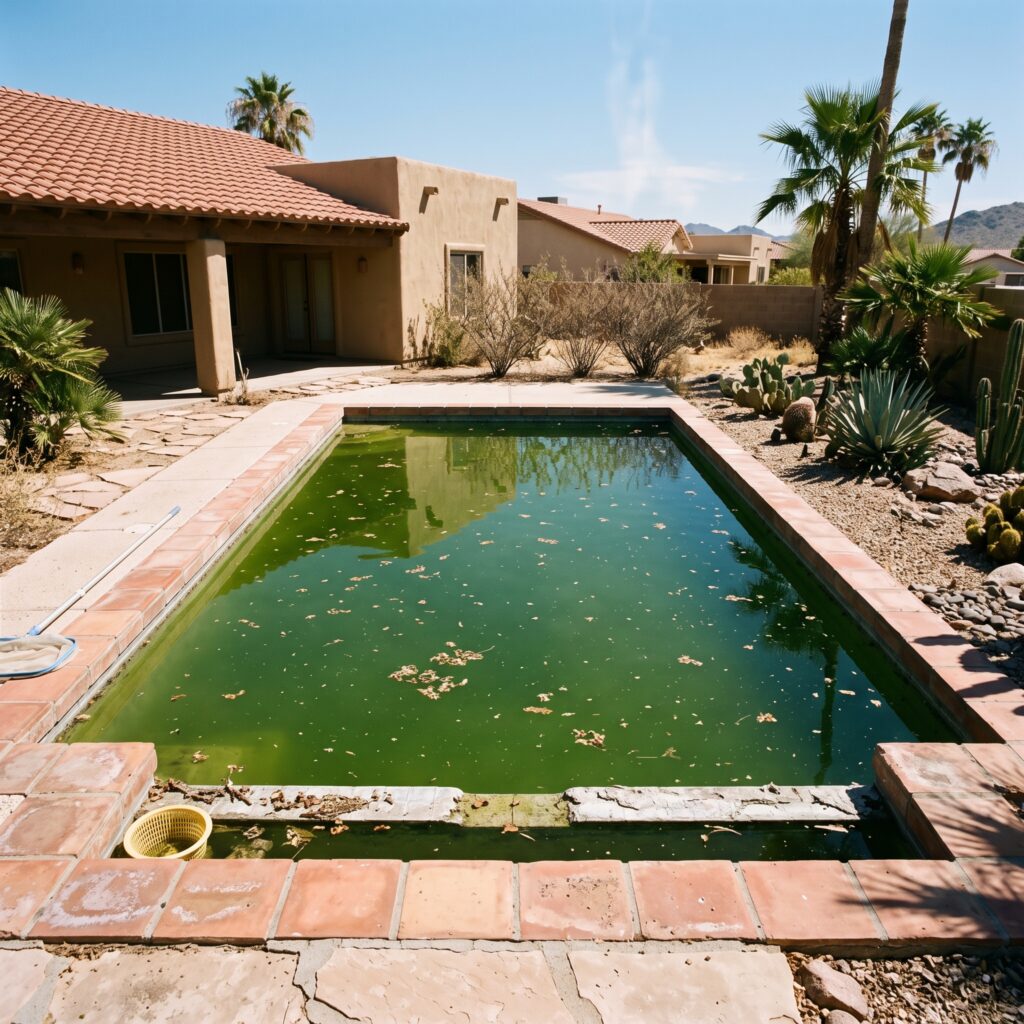
How do I get my pool water from green to clear?
Test pH, free chlorine, and cyanuric acid pool levels, identify algae versus metals, then run the correct pool algae treatment or metal sequestrant use, brush, and filter hard.
Here’s the step-by-step our crew follows on service routes when chlorine shock results in green water:
1) Test and note the basics
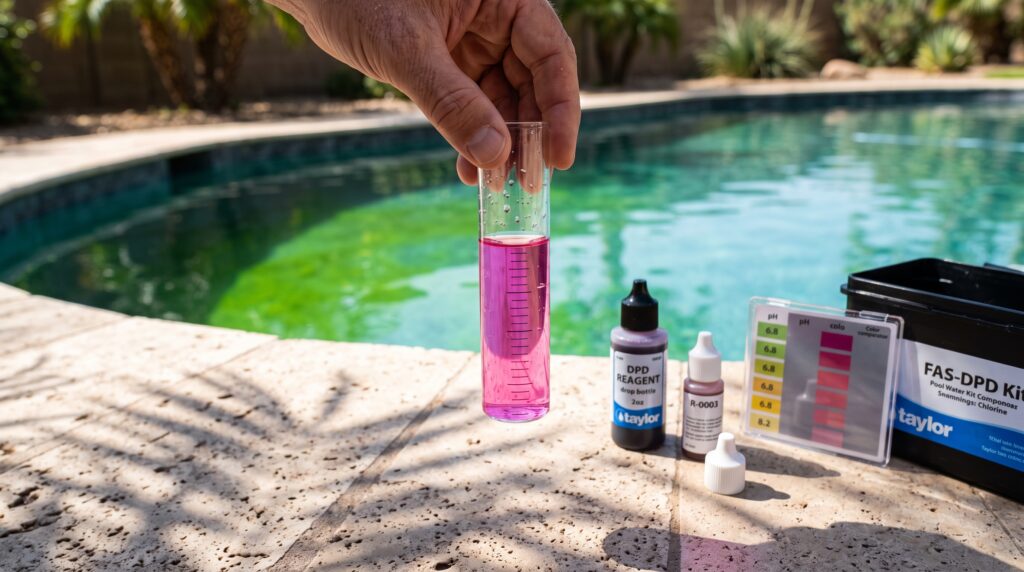
- Use a FAS‑DPD drop kit for accuracy. Strips swing too much.
- Targets before treatment:
- pH: 7.2-7.6
- Free Chlorine (FC): depends on CYA (details below)
- Cyanuric Acid (CYA): 30-50 ppm for outdoor pools
- Total Alkalinity: 70-110 ppm
- If pH is above 7.8, correct it first with muriatic acid. High pH pool symptoms include green tinge with strong chlorine smell and weak kill power. Chlorine works best near 7.2-7.4.
2) Decide: algae or metals
- Clear, yellow‑green tint right after dosing, no cloud, and sometimes brown filter water points to metals. That’s iron in pool water green tint territory. Copper in pool water green tint usually looks more blue‑green and may tint blonde hair.
- Cloudy green, slimy walls, or fine green dust that puffs when brushed is algae.
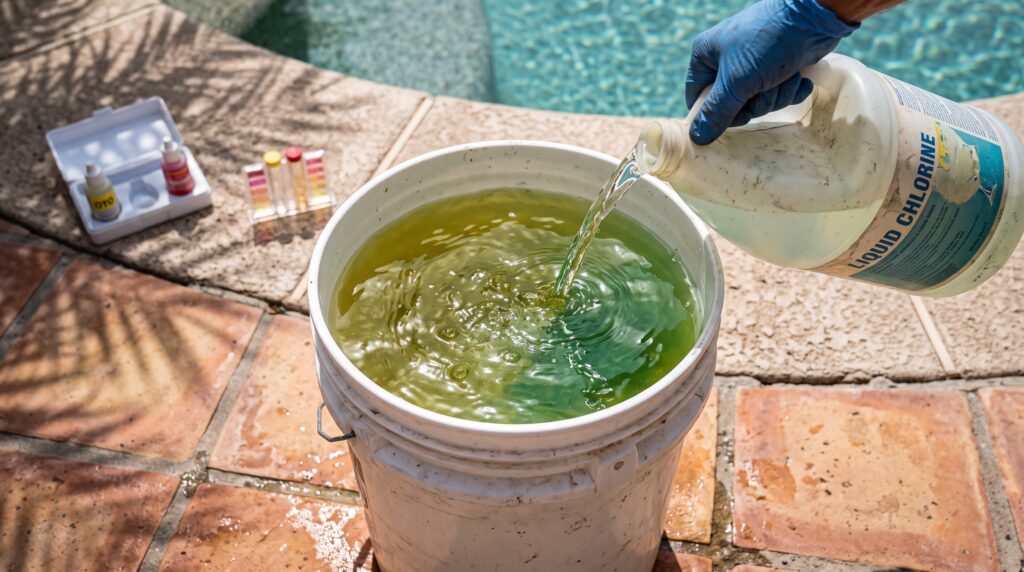
- Quick check: fill a white 5‑gallon bucket with pool water. Add a teaspoon of liquid chlorine as an oxidizer pool chemical. If it flashes tea‑yellow to emerald and stays crystal clear, think metals. If it goes milky or throws green dust, think algae.
3A) If it’s metals (iron or copper)
- Lower pH to 7.2. Lowering pH keeps metals in solution and reduces surface staining risk.
- Add a metal sequestrant (HEDP or phosphonic acid based), per label for your gallons. This is where metal sequestrant use matters. It doesn’t remove metals; it binds them so the water looks clear.
- Run the pump 24/7 for 24-48 hours. Clean the filter as pressure rises 20-25% over clean baseline.
- If you just filled from a well, plan on repeat sequestrant doses weekly for a month. Consider partial drain/refill from a metal‑free source or a pre‑filter on the hose.
- Avoid strong shock for 48 hours after sequestrant, or you’ll burn it off and the tint returns.
3B) If it’s algae
- Drop pH to 7.2.
- Bring FC up to shock level that matches your CYA. As a rule we run near 40% of CYA for a hard hit. Example: at 40 ppm CYA, hold ~16 ppm FC until algae dies off.
- Use plain liquid chlorine (10-12.5% sodium hypochlorite). It’s fast and doesn’t add more CYA or calcium.
- Brush walls and floor with a nylon brush twice daily. Dead algae only leaves when you move it to the filter.
- Run the pump nonstop for 48-72 hours. Backwash sand/DE when pressure rises 20-25%. Rinse cartridges daily if they load up.
- If the pool is a swamp, vacuum to waste first so you’re not clogging the filter with muck.
- Optional: add a clarifier once the water turns from green to cloudy blue to speed polishing. Skip floc if you don’t have a multiport or a way to vacuum to waste.
4) Re-test, then hold
- Test FC and pH every 6-8 hours on day one. Keep FC at shock level until the water clears and you get zero visible algae on brush.
- When clear, let FC drift back to a normal range that matches CYA. Keep it there daily.
5) Cost and time reality
- Expect $20-$60 in liquid chlorine for a mid‑size 15,000-20,000 gallon pool on a full algae cleanup.
- Expect $18-$35 per quart for quality sequestrant, sometimes two quarts on heavy iron fills.
- Most clear‑up jobs run 1-5 days depending on cause and filter type.
When to call a pro vs. DIY:
- Call a pro if CYA tests over 90 ppm, metal stains are spreading, or you’ve got copper etching from the heater. Those need partial drains, stain treatments, or equipment checks. DIY is fine for a light bloom or a one‑time iron tint after a hose fill.
Should I add more chlorine if my pool is still green?
Add more chlorine only if you’ve confirmed algae and your CYA supports it; stop adding chlorine if the green is from metals or your pH is high.
Our techs use this approach on problem pools:
- Green and cloudy with slime on walls? That’s algae. Raise FC to shock level and hold it there. This is pool algae treatment, not a one‑and‑done dump.
- Green but crystal clear right after dosing? Metals oxidized. Don’t keep shocking. Lower pH, add sequestrant, and circulate.
- Strong chlorine smell with green tint and eye burn? Usually high pH pool symptoms and chloramines. Lower pH to 7.2 and add a measured oxidizer pool chemical dose to break chloramines, then reassess color.
How to dose chlorine right for algae
- Pick your target FC based on CYA:
- CYA 30 ppm: shock around 12 ppm FC.
- CYA 40 ppm: shock around 16 ppm FC.
- CYA 50 ppm: shock around 20 ppm FC.
- Liquid chlorine math for a quick hit:
- In 15,000 gallons, 1 gallon of 10% liquid chlorine raises FC by about 6.7 ppm.
- Example: At CYA 40 ppm, starting from 2 ppm FC, you need roughly 2.1 gallons of 10% to reach ~16 ppm.
- Keep testing and topping back to your target until the green is gone and FC holds overnight with no more than a 1 ppm drop.
When not to add more chlorine
- Metals: If iron in pool water green tint shows up right after shock, switch to sequestrant and filtration.
- Off‑the‑charts CYA: If your stabilizer reads sky‑high, chlorine gets “bound” and slow. Don’t keep pouring. Do a partial drain and refill to lower CYA, then resume.
- pH 7.9 or higher: Lower pH first. High pH blunts chlorine’s kill rate, and you’ll waste product.
Granular dichlor and trichlor tabs add CYA every time you use them. If your cyanuric acid pool levels creep too high, they fuel the problem you’re trying to fix.
How long does it take for a green pool to clear up after treatment?
Metal‑caused green usually clears in 4-24 hours with sequestrant and strong filtration, while true algae blooms take 2-5 days of maintained shock and brushing.
Three factors control the timeline:
- Cause: metals clear fast once bound; algae needs kill time and removal.
- Filter: DE polishes fastest, cartridge next, sand is slower but steady.
- Load: the heavier the bloom, the longer the grind.
Typical timelines we see on route
- Fresh‑fill iron tint: 6-12 hours to go from apple‑green to clear, if pH is set low and the sequestrant dose is correct.
- Light algae bloom (you can still see the main drain): 24-48 hours to clear after raising FC to proper shock, with steady brushing.
- Heavy bloom (pea soup): 3-5 days. Expect daily backwashes and heavy vacuuming.
- Copper oxidation: 12-48 hours, but can reappear if pH drifts high or a heater is dissolving copper into the water.
How to speed it up
- Run the pump 24/7 until fully clear.
- Backwash sand/DE as soon as pressure hits 20-25% over clean. Cleaning restores flow and capture.
- For cartridges, rinse daily on day one and two if they load with fine dead algae.
- Brush twice daily. Dead algae settles. You have to put it into motion to get it filtered.
- Once the water turns from green to cloudy blue, a clarifier can shave 12-24 hours on sand systems.
If you’re two days in with no change, stop and retest everything. Re‑check pH, FC, and CYA. Green that won’t budge after correct shock often points to sky‑high stabilizer or a hidden metal problem.
Can chlorine fix a green pool?
Chlorine fixes algae and chloramine issues, but it doesn’t remove metals or overcome extreme stabilizer; metals need sequestrant and high CYA needs dilution.
What chlorine does well
- Kill algae when FC is high enough for your stabilizer level and held there. That’s the whole job for a bloom.
- Oxidize combined chlorine and clear up hazy water once the organics are dead.
- Maintain a sanitary residual so algae can’t come back once you’ve cleared it.
What chlorine can’t do
- Pull metals out of the water. Strong shock actually triggers the problem with metals present. It oxidizes iron and copper and creates that green tint.
- Work well at high pH. At 8.0, you’re fighting an uphill battle.
- Work fast when cyanuric acid pool levels are too high. Past ~70-80 ppm, response slows and you burn money.
- Repair a heater that’s feeding copper. If the source isn’t fixed, the green tint returns every time you shock.
Where algaecide fits
- If you want insurance after a cleanup, a non‑foaming polyquat 60 works as a backup, especially before a vacation. It’s not a replacement for chlorine, but it helps nudge the odds.
Use chlorine for algae and sanitation. Use sequestrant for metals. Use water replacement for extreme CYA. Keep pH in range so the chemistry actually works.
What causes a pool to turn green after adding chlorine?
The common causes are oxidized metals in the water, high pH reducing chlorine strength, excess cyanuric acid binding chlorine, and an existing algae load that needed a higher, sustained dose.
Reasons for green pool water after adding chlorine
- Iron in pool water green tint: Fresh fill from a well or old galvanized lines often brings dissolved iron. Chlorine oxidizes iron to a yellow‑green color that looks green in the blue pool.
- Copper in pool water green tint: Dissolved copper can come from low‑pH water attacking a copper heater or from some copper‑based algaecides. It goes blue‑green after a strong oxidizer pool chemical hit.
- High pH pool symptoms: Above 7.8, chlorine’s kill rate falls. You can add chlorine and still see green from sluggish sanitizer performance.
- High cyanuric acid pool levels: Too much stabilizer ties up a chunk of your free chlorine. You shock, it looks better for a minute, then it slides back to green.
- True algae: The dose wasn’t enough for the level of algae and the current CYA. Algae wins the first round and clouds the water.
How to tell algae from metals in five minutes
- Clarity test: Metals usually look clear with a green/yellow cast. Algae looks dull or cloudy, even with a bright tint.
- Brush test: Metals don’t puff when brushed. Algae throws a smoky cloud or reveals slime.
- Vitamin C spot test: Press a crushed vitamin C tablet in a sock on a yellow‑brown surface stain for 60 seconds. If it lightens, iron is involved.
- Bucket test: White bucket + pool water + a teaspoon of liquid chlorine. Clear water that shifts color = metals. Cloudy with debris = algae.
- Filter output: Metals often turn your filter rinse water yellow‑brown. Algae cleanup rinse looks grey‑green.
Troubleshooting pool water color changes speeds up once you match the symptom to the cause. Then the fix becomes simple chemistry, not guesswork.
| Cause | Solution |
|---|---|
| Iron oxidation after shock | Lower pH to 7.2, dose HEDP sequestrant, circulate 24-48 hours, clean filter; avoid heavy shocking for 48 hours. |
| Copper oxidation after shock | Test pH and heater for corrosion, dose sequestrant, hold pH 7.2-7.4, consider switching off copper algaecides. |
| High pH weakening chlorine | Add muriatic acid to 7.2-7.6, then resume normal chlorination. |
| High CYA “chlorine lock” | Partial drain/refill to 30-50 ppm CYA, then shock to the matching FC level and hold. |
| True algae bloom | Lower pH to 7.2, raise FC to shock level for your CYA, brush twice daily, run pump nonstop, backwash as needed. |
Cost and gear reality check
- Liquid chlorine: $6-$12 per gallon in most stores, 10-12.5% strength. Plan 2-6 gallons for a mid‑size pool on day one of a cleanup.
- Sequestrant: $18-$35 per quart. Heavy iron jobs often need 2 quarts up front.
- Test kit: A FAS‑DPD kit runs more than strips, but it tells you what’s really in the water. It pays for itself in one bad bloom.
Keep your pool water chemistry steady after the fix:
- FC: Hold a daily residual that matches CYA. At 40 ppm CYA, we keep 4-6 ppm FC.
- pH: 7.2-7.6. Nudge it down before big shock jobs.
- CYA: 30-50 ppm for most outdoor pools. If you habitually use tabs, test CYA monthly during summer.
Quick-fire Q&A
Why is my pool green after adding chlorine?
It’s usually metals oxidizing, high pH blunting chlorine, high CYA binding chlorine, or a live algae load that needed more sustained shock.
How do I know if it’s algae or metals?
Clear green or yellow‑green right after dosing points to metals; cloudy green with slime points to algae. A white‑bucket-and-chlorine test confirms it fast.
What’s the fastest way to clear green from metals?
Lower pH to about 7.2, add an HEDP‑type sequestrant per label, run the pump continuously, and clean the filter as pressure rises. Most clear in under a day.
Can I just keep shocking until the green goes away?
If it’s algae, yes, hold shock level that matches your CYA and brush hard. If it’s metals, more shock makes the tint worse; use sequestrant instead.
What FC level should I target at CYA 40 ppm?
For a cleanup, about 16 ppm. Keep pH near 7.2-7.4 during cleanup so chlorine works faster.
Will clarifier fix green water?
No. Clarifier helps polish once algae is dead. It won’t kill algae and won’t stop new metal oxidation.
When should I call a pro?
Call when CYA is over 90 ppm, stains keep returning after sequestrant, or a heater is feeding copper. Those need drainage plans or equipment checks.
Back to blue
Figure out if the green is algae or metals first. Chlorine handles organics when you match it to your cyanuric acid pool levels, and sequestrant handles iron and copper without the color show. One small insight from years on route: most “mystery greens” start with a CYA that climbed quietly from months of tabs, so check that number first before you pour more shock. If you’re stuck between two diagnoses, send us a photo and your test readings, and we’ll tell you where to start today.
Mike, PHX Pool Crew lead technician, servicing East Valley since 2019